




















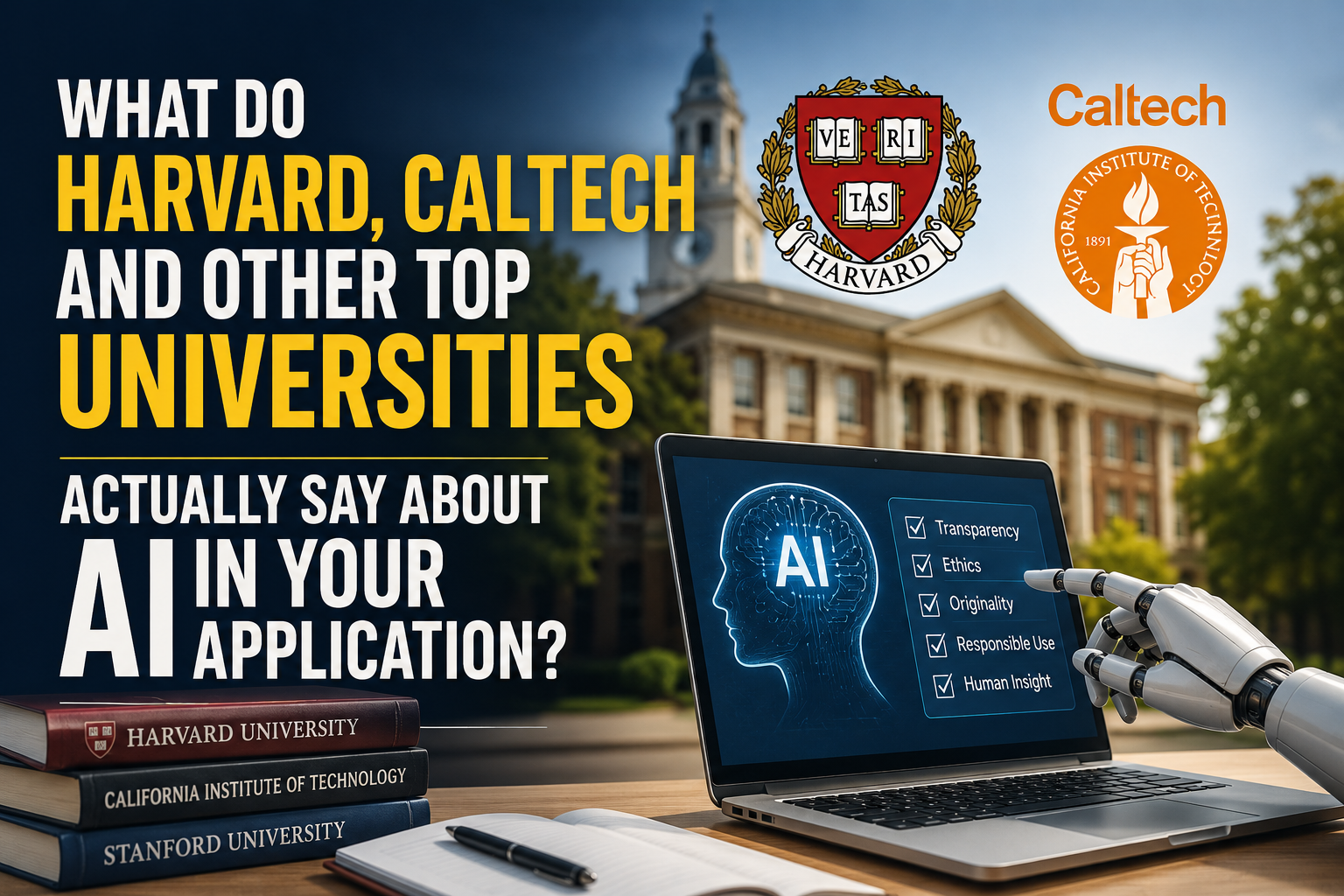
If you’re applying to university or graduate school right now, there’s a good chance the institution you’re targeting has already published an AI college application policy. And while the rules aren’t identical everywhere, there is a clear pattern: universities are increasingly drawing a line between using AI as a tool and allowing AI to create the work you submit as your own.
Here’s a look at what some leading universities actually say about AI use in college applications.
United States
The University of Michigan’s Rackham Graduate School has one of the clearest AI policies for college admissions—at least for graduate applicants. AI may be used to search for guidance on the application process or to review grammar and spelling, much like Grammarly. But applicants may not use it to outline, substantively draft or write their application essays, or to generate prose that replaces their own voice. Applicants must also attest that they are the sole author of their written passages. False attestation can result in an admission offer being revoked.
Caltech takes a similarly firm position. Its guidelines for applicants say that relying on AI to craft an essay can dilute an applicant’s “unique expression and perspective.” Its guidance also draws a useful distinction between using AI for general assistance and having it create the substance of your application. Failure to comply may result in an offer of admission being rescinded.
Harvard focuses less on prescribing which AI tools can be used and more on the principle of authorship. Its admissions guidance says an essay should reflect the student’s own content, writing style and English proficiency. Passing off AI-generated material as your own violates its standards and can result in an offer being withdrawn—or admission being revoked after enrollment.
Brown is similarly explicit, although its policy is slightly more permissive. Applicants may use AI for basic spelling and grammar review, but the content of essays and short-answer responses must be their own. Brown treats submitting substantive AI-generated content as application misrepresentation.
Yale also distinguishes between assistance and authorship. Applicants may use AI for grammar or spelling review, general advice and topic suggestions at the beginning of the writing process. But submitting substantive AI-generated content—including an AI-written personal statement—constitutes application fraud and can result in admission being revoked.
The issue also exists at the application-platform level. The Common Application, used by more than 1,000 colleges and universities, has its own Fraud Policy. It says applicants must not misrepresent the substantive content or output of an AI platform as their own original work. In other words, even before a university applies its own AI policy for college applications, applicants using Common App have made a commitment that the work they submit is genuinely theirs.
Beyond the USA:
The same authorship question is appearing in the UK, although the rules vary by institution and sometimes even by programme.
UCAS, the UK’s centralised university application service, allows applicants to use AI to support tasks such as brainstorming, research and proofreading. But it warns that generating and submitting all or a large part of a personal statement as your own words could be considered cheating.
Cambridge draws a particularly sharp distinction. For undergraduate applications, it allows AI to help with ideas and research, while warning against over-reliance on it. For postgraduate applications, the rule is stricter: AI must not be used when writing personal statements or CVs, including to help with English.
Oxford advises applicants to check the policy of their specific programme. Its Careers Service warns that AI-drafted applications can sound generic and uninteresting—an issue we explored in the second post in this series.
The common pattern
Read enough of these AI policies for college applications side by side, and it becomes clear: universities aren’t necessarily trying to ban AI as a tool. They’re trying to protect authorship.
The permitted uses vary. Some schools allow brainstorming. Some allow editing. Grammar and spelling checks are widely permitted. Cambridge permits different uses for undergraduate and postgraduate applications. And some programmes, such as the Rhodes Scholarship, even allow limited GenAI assistance while requiring applicants to disclose that use and attest that their statement remains their own work.
But they are all consistent about one thing: it is not ok to produce the content of an essay with AI and then submit it as your own. This distinction matters because an application essay isn’t simply another piece of writing. It is evidence of how you think, what you’ve experienced and how you express yourself.
So before you use ChatGPT, or any other AI tool, for your application, don’t just ask, “Can I use AI?” Ask a more useful question: What does this university’s AI college application policy actually allow me to use it for?
And whatever the answer, keep one rule in mind: assistance is fine; authorship must be yours.
If you’d like help making sure your SOP is both strong and unmistakably your own, get in touch for a free consultation.