





















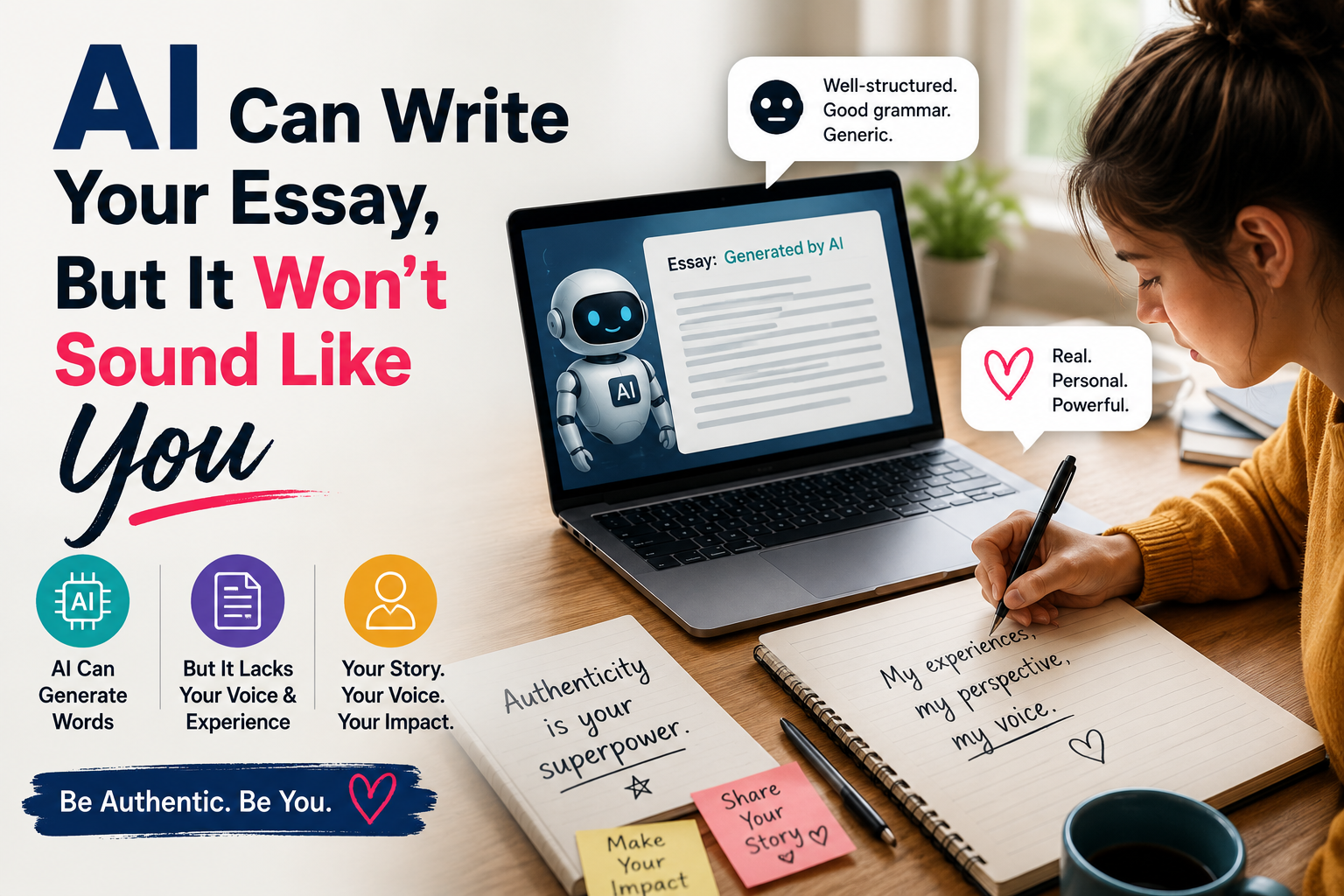
Can AI really replace a personal essay? In 2025, researchers at Cornell set out to test exactly that, comparing 30,000 human-written college admissions essays with essays generated by eight popular large language models, including ChatGPT. They found something striking: AI-generated college essays were far more similar to one another than human-written essays were.
A college essay is supposed to do something a résumé and transcript can’t: give an admissions committee a glimpse of the individual behind the application. If an AI-written college essay sounds polished but interchangeable with thousands of others, it is doing just the opposite of what it’s supposed to.
AI essays sound like each other, not like you
The Cornell researchers measured linguistic variation across the essays and found that AI-generated writing was considerably more homogeneous than human writing. In other words, two AI college essays tend to look more like each other than two essays written by real students.
That makes sense when you think about how these systems work. A language model generates text by predicting what words and phrases are most likely to come next. Human beings, meanwhile, are inconsistent. We digress. We use specific examples from our lives. We choose an unexpected word because it feels right to us. We have writing habits and quirks that aren’t the most statistically likely way of expressing an idea.
That individuality is just what disappears when you use AI to write a college essay.
And this isn’t just one study. A separate 2024 study published in the Journal of Big Data compared more than 150,000 human-written college admissions essays with more than 25,000 essays generated by GPT-3.5 and GPT-4. It found that AI-generated writing showed less variation than human writing. Interestingly, it also noted that AI essays were stylistically closer to essays associated with male, more socially privileged applicants.
Even prompted to sound different, it couldn’t
The 2025 Cornell study tested something even more curious. Researchers gave the AI models additional information about each applicant—their sex, race, first-generation status and geographic location—and asked them to generate essays with those characteristics in mind.
It didn’t solve the problem.
The identity-prompted essays remained linguistically distinct from real human essays, and prompting the models to sound like a particular kind of person did little to reproduce the natural variation found in people from those groups. In fact, the prompted and unprompted AI essays were more similar to each other than either was to the human writing.
So telling ChatGPT to “make this sound more personal” doesn’t necessarily make an AI-generated college essay personal. It may simply make a generic piece of AI writing sound slightly more personalised.
Why this matters more than “will I get caught”
This isn’t a story about AI detection software and what you can get away with. The deeper point is that college application essays exist specifically to capture your particular way of thinking, noticing and explaining yourself. An AI-written essay can be fluent, grammatical and impressive. But those qualities aren’t the same as having a distinctive voice.
None of this makes AI useless in the process. As we covered in the first post in this series, it can be useful for brainstorming, checking structure or reviewing grammar. But the moment it starts generating the actual sentences meant to sound like you, it works against the one real advantage a specific, occasionally imperfect voice has over a very fluent, very average one.
It’s worth remembering what admissions committees are actually trying to find. They aren’t looking for the applicant who can produce the most polished AI college essay. They’re trying to work out whether a real, specific person is behind it.
Universities aren’t looking for perfect essays. They’re looking for real ones. And “real” happens to be the one quality no amount of AI polish can generate.
Want an outside opinion on whether your own draft sounds like you? Get in touch — we’d be glad to take a look.