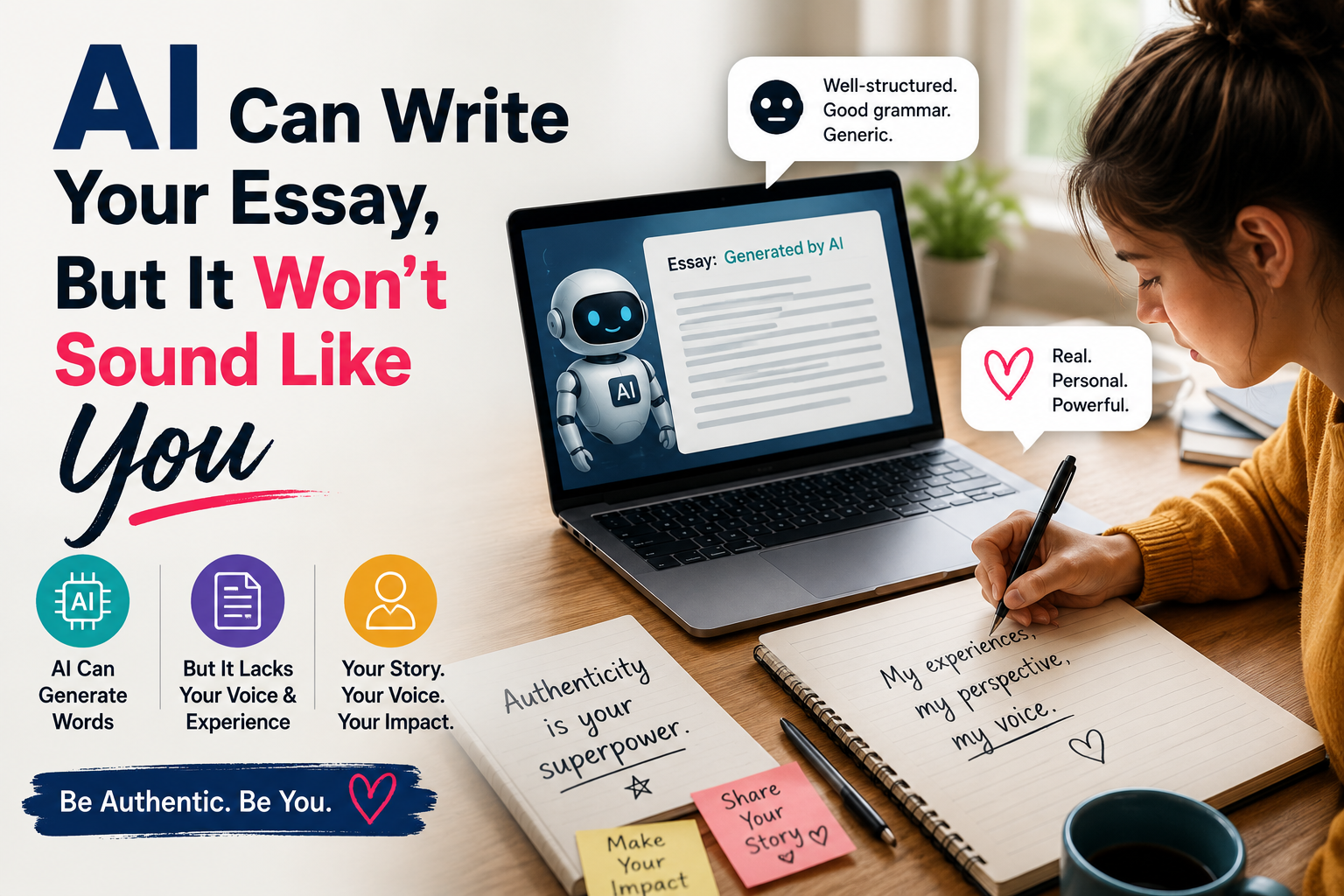





















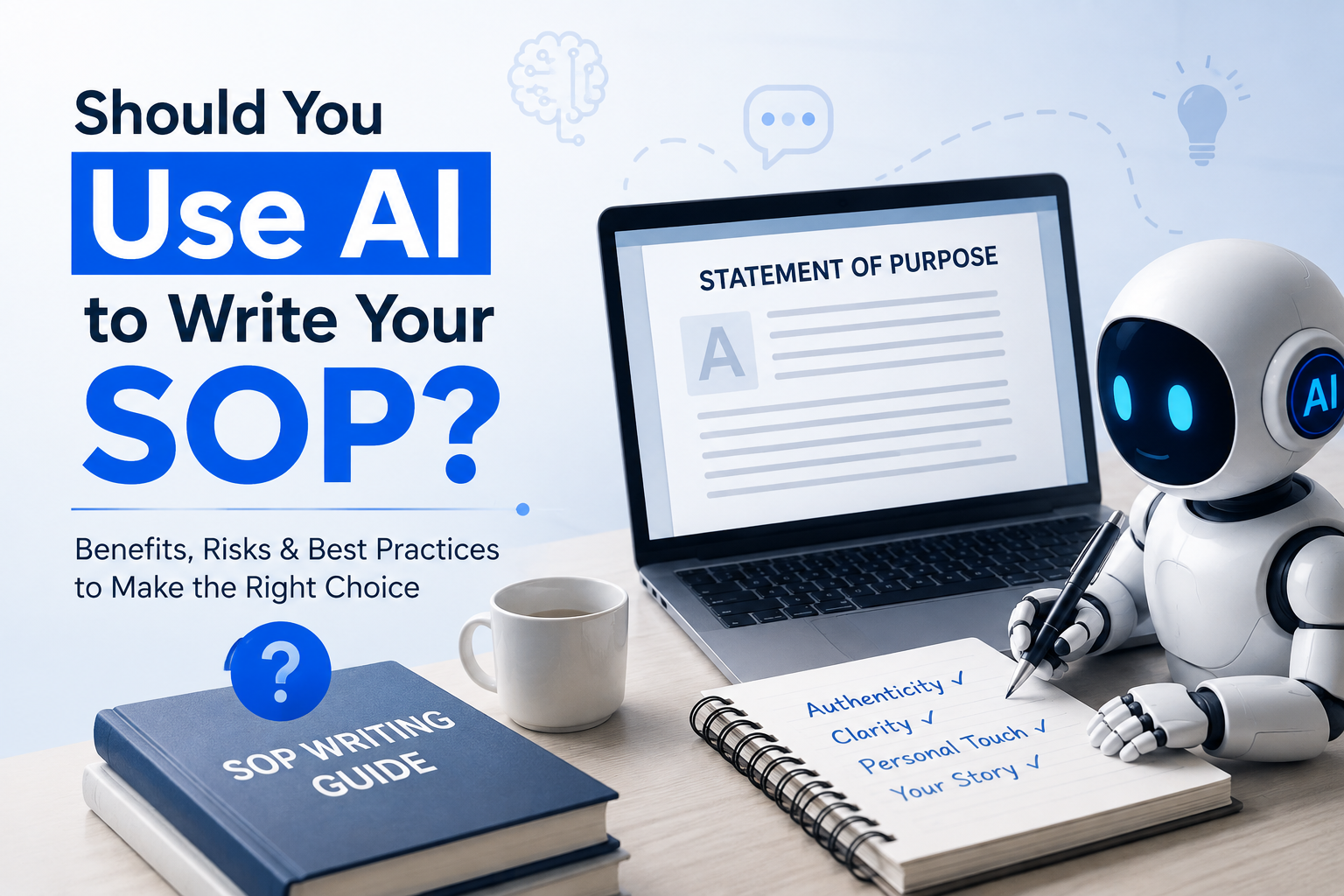
Ask any Master’s applicant right now, and there’s a good chance they have a chatbot open while writing their Statement of Purpose. A 2024 survey, later cited by Inside Higher Ed, found that roughly half of college applicants use AI to brainstorm their essay, and about one in five use it to produce an actual first draft. Basically, using AI for application essays is no longer a fringe habit. It has become part of how the current generation of applicants works on their essays.
It’s no surprise that applicants are flocking to AI for help. An SOP asks you to distill your life on paper, to look back at the years and make good meaning of it. It asks you to sound confident and self-aware, often in a second language. It’s not exactly easy work. A tool that can produce something fluent and organised in thirty seconds can be tempting.
But “easy to produce” and “safe to submit” are two very different things—and not knowing which is which can get students into trouble. Before you use AI for an SOP, it is worth understanding what universities say about it.
Where do universities draw the line?
Several universities have now published clear guidance on AI use in university applications, and there’s a fairly consistent direction to it. By and large, using AI to search for guidance on the application process, structure/outline your essay, or check grammar and spelling the way you’d use Grammarly, is considered acceptable (we’ll come to specific university guidelines in part 3 of this series). But using AI to generate the actual content of your essay is not—regardless of whether you copy the output directly or heavily edit it afterward.
The distinction isn’t about how visible the AI is in the final text; it’s about who actually did the thinking.
Caltech’s admissions office offers a simple gut-check for using AI for a Statement of Purpose: if a task wouldn’t be fair to hand to a trusted teacher, it isn’t fair to hand to an AI tool either. Having someone check your spelling is fine. Having them write a paragraph for you to submit as your own is not. The same standard applies to a chatbot.
Why the cost of an AI-generated SOP is very high
Most competitive graduate applications now require you to formally attest that you’re the sole author of your essays. They treat AI-generated SOP content submitted as an applicant’s own work not as a grey area, but as a form of application fraud. Universities such as Michigan and Caltech are explicit that admission can be revoked, even after the fact, if that attestation turns out to be false. In fact, this is written into the policy documents applicants agree to before they hit submit.
So how can you safely use AI for SOP writing?
AI shouldn’t be doing the one thing an SOP actually exists for: showing an admissions committee who you are, in your own words, with your own reasoning. Hand that part over, and you haven’t just taken a shortcut—you’ve flouted the rules.
However, if used judiciously, AI can be a big help. It can be a brainstorming partner, a way to sanity-check your structure, or a grammar pass once your own draft is ready. It can be useful as a tool around the writing process—but it shouldn’t become the writer.
Navigating the slippery slope
The problem is, you might intend to use AI the right way, only to slip into the wrong ways. Ask an AI tool to check the structure of your essay, and it may suggest a paragraph to make your argument stronger. Ask it to improve a sentence, and it may rewrite the whole thing. Before you know it, you may find yourself copying language you didn’t write. If you do use AI for an SOP, be explicit about its role in the prompt: tell it to act as a brainstorming or editing partner, not to generate text for you. The moment you’re copying sentences or paragraphs, you’re crossing the line.
In the next post in this series, we’ll look at what happened when researchers actually compared AI-written essays to real ones. The results might change how you think about AI and application essays.